
Accelerated learning and school-age children in Colombia: challenges for educational inclusion
DOI:
https://doi.org/10.66707/getc.v1i01.52Keywords:
School-age children, Accelerated learning, Educational inclusion, Education policy, ColombiaAbstract
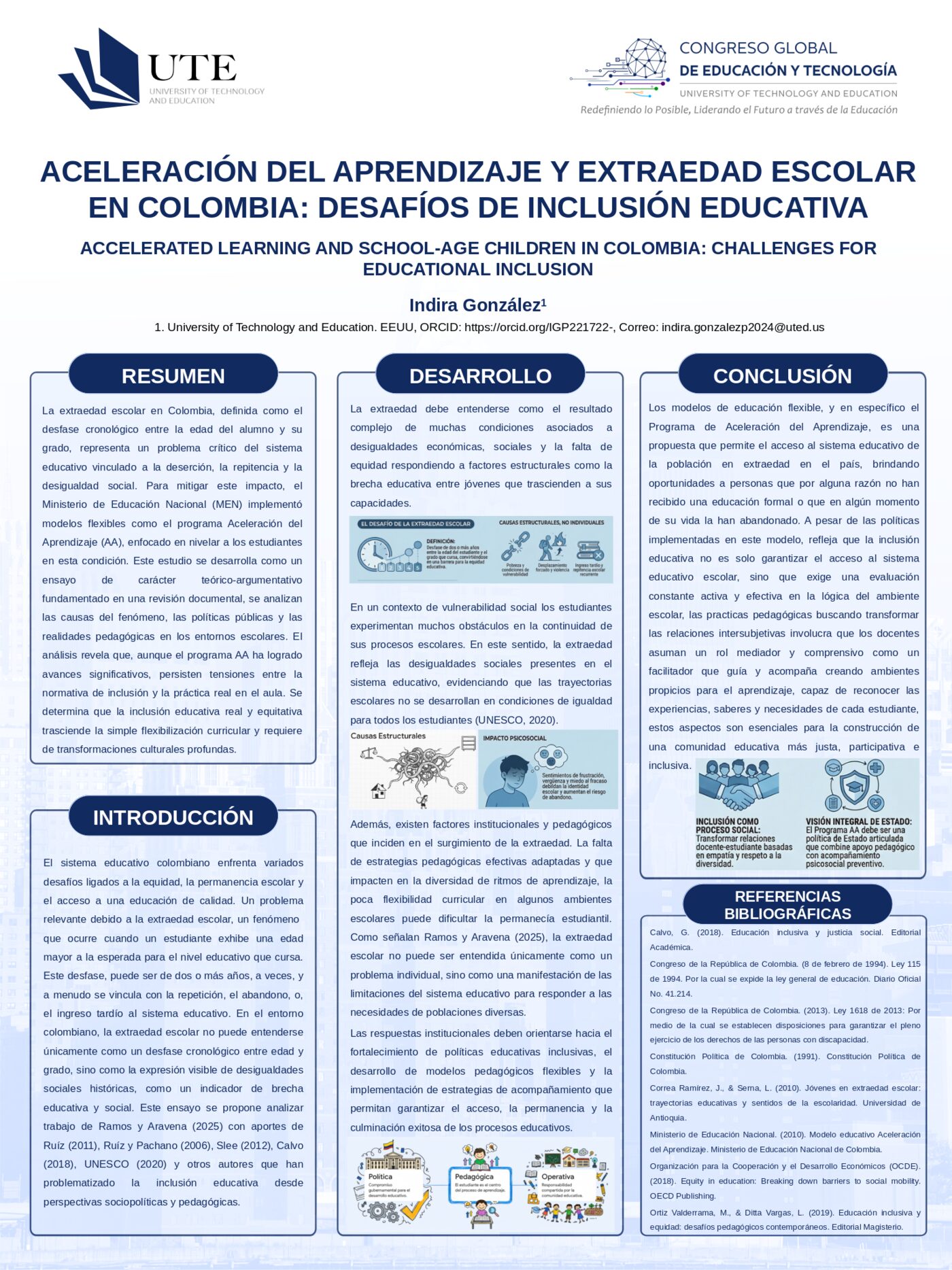
In Colombia, school age discrepancy refers to the gap between a student’s age and the grade level they are currently enrolled in; it could be one of the fundamental problems facing the Colombian education system. This issue is linked to phenomena such as school dropout rates, potential emotional and social impacts, grade repetition, and social inequality. In response to this situation, the Ministry of National Education (MEN), recognizing age-grade mismatch as a challenge, has implemented flexible educational models to serve students in this situation, including the Accelerated Learning (AL) program, designed to bring students with an age-grade gap up to grade level by reducing the age discrepancy. This essay is theoretical and argumentative in nature; it critically analyzes the relationship between being behind in school, the Accelerated Learning model, and the challenges of educational inclusion in Colombia. Through a literature review, this study examines the general causes of this phenomenon, the policies implemented, and the pedagogical challenges in the classroom; tensions exist between inclusive regulations and pedagogical practice in the classroom. Evidence shows that the implementation of the Learning Acceleration Program represents significant progress in this context, yet its adoption reveals limitations regarding teacher training, curricular flexibility, and student stigmatization. It is concluded that real, effective, and equitable inclusion in a highly diverse context requires not only curricular flexibility but also cultural transformations, teacher training, and recognition of diverse educational trajectories influenced by social and personal factors.
Downloads
Downloads
Published
How to Cite
Issue
Section
License
Copyright (c) 2026 Global Education and Technology Congress

This work is licensed under a Creative Commons Attribution-NonCommercial-ShareAlike 4.0 International License.


