
Youth Impulsivity Driven by the Viral Spread of Emotions on Social Media: A Critical Perspective on Coexistence in School Environments
DOI:
https://doi.org/10.66707/getc.v1i01.57Keywords:
Cyberbullying, Digital interaction, Emotional self-regulation, Competencies education, Socioemotional well-beingAbstract
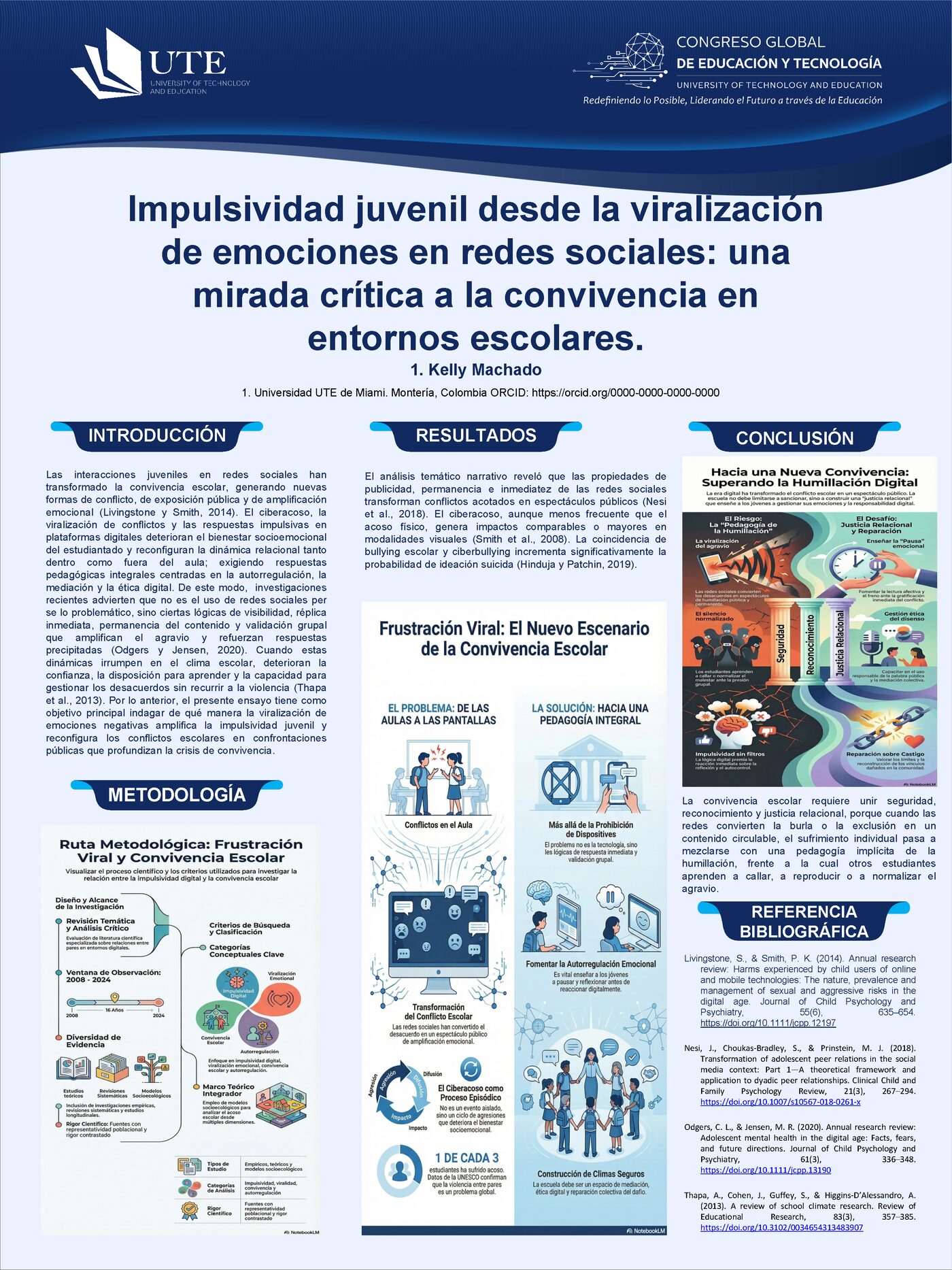
This essay examines how the viral spread of negative emotions on social media increases impulsiveness among adolescents and turns school conflicts into public confrontations, thereby weakening coexistence and socio-emotional well-being among students. It provides a thematic review and critical analysis of studies on peer relationships in digital spaces, cyberbullying, school climate, self-regulation, adolescent mental health, and the impacts of constant platform-mediated interaction. The main argument indicates that the problem is not with social media itself but with specific features such as visibility, instant responses, content permanence, and group validation, which amplify offenses, reinforce impulsive reactions, and extend harm beyond the initial incident. The conclusion stresses that the current crisis in school coexistence requires viewing digital conflict as a relational experience with pedagogical implications—one that demands emotional self-regulation, ethical online behavior, school mediation, and educational environments that uphold dignity, encourage participation, and support collective healing.
Downloads
Downloads
Published
How to Cite
Issue
Section
License
Copyright (c) 2026 Global Education and Technology Congress

This work is licensed under a Creative Commons Attribution-NonCommercial-ShareAlike 4.0 International License.


