
Social representations in education: a hermeneutic reading from the interpretive paradigm in tenth and eleventh-grade students
DOI:
https://doi.org/10.66707/getc.v1i01.54Keywords:
Secondary education, Hermeneutics, Interpretive paradigm, Pedagogy, Social representationsAbstract
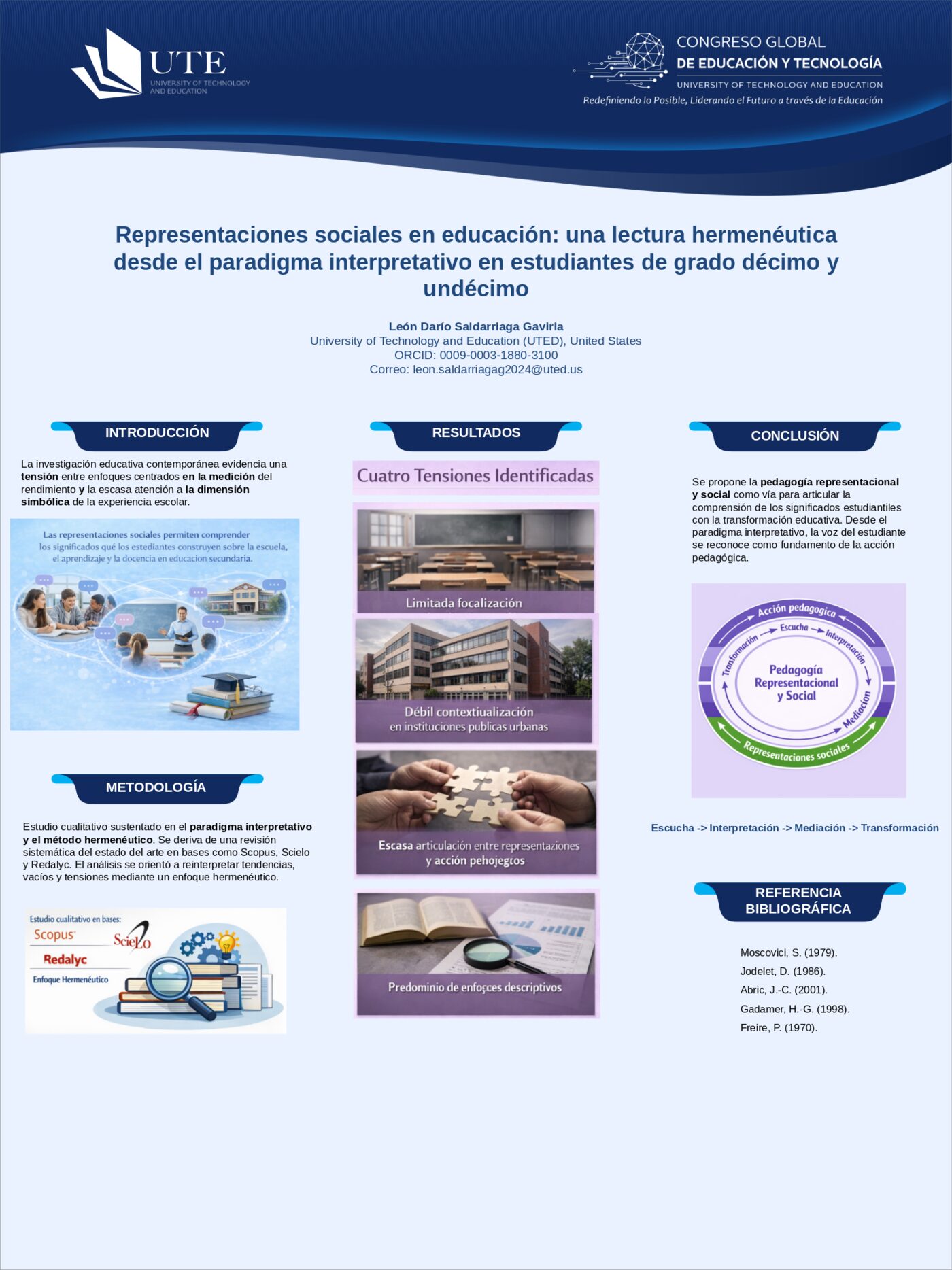
Contemporary educational research reveals a tension between the predominance of performance-measurement approaches and the insufficient consideration of the symbolic dimension of the school experience. In this context, social representations allow for an understanding of the meanings that students construct regarding school, learning, and teaching, particularly at the secondary education level. Methodologically, this study is framed within a qualitative approach grounded in the interpretive paradigm and the hermeneutic method, derived from a systematic review of the recent state of the art on social representations in education. Based on this corpus, a hermeneutic analysis was developed to reinterpret research trends, theoretical gaps, and epistemological tensions within the field. The results evidence a limited focus on tenth- and eleventh-grade students, a weak contextualization in Latin American urban public institutions, and an insufficient articulation between the analysis of social representations and their pedagogical projection; likewise, a predominance of descriptive approaches is identified, which restricts the understanding of the symbolic nature of the school experience. In conclusion, this study contributes to the educational field by proposing a representational and social pedagogy grounded in students' sense-making processes, recognizing the student voice as the foundation of pedagogical action.
Downloads
Downloads
Published
How to Cite
Issue
Section
License
Copyright (c) 2026 Global Education and Technology Congress

This work is licensed under a Creative Commons Attribution-NonCommercial-ShareAlike 4.0 International License.


